Logics of writing
Writing is a technique for managing the future when it comes to how one is seen. One of the few reasons to write (a book, an article, or a blog) or to record (a podcast, a lecture, or a talk) is to give those who come after you (for example, your own children) a chance to look at those who came before without having to resort to the methods of historical research.
Any research is autobiographical. My interest in the Chernobyl disaster and Soviet nuclear power as social phenomena became autobiographical first, and only then properly research‑oriented. My father, Viktor Kozlov, took part in the clean‑up of the Chernobyl accident. Because of its consequences he passed away early, so this event is an important part of my family history.
Although our family photo albums contain many photographs of my father where you can examine him in detail, my favourite photograph of him is the one where he cannot be seen at all. Moreover, I have never actually held it in my hands.
It is a photograph of students taken in the summer of 1966, after they had built a cowshed on virgin land in Kazakhstan. You can tell from their faces that they should have chosen a different place for the shot: the sun is beating straight into their eyes, and all the students are squinting. The cowshed itself is not in the frame; instead you see the tents. Unlike the Obninsk nuclear physicists with their penchant for double‑breasted jackets and soft hats, everyone here is dressed simply. You cannot pick my father out in the picture, but the caption tells us that he is there. I stumbled across this image by chance while sorting through Rosatom’s archival photographs – and I froze.
The shock of this kind of recognition is understandable: a historian must be intimately familiar with their archives, but family intimacy belongs to experiences of a different order and to other social worlds. For an autobiographical interest to become a research interest, it has to pass through procedures of purification. The first of these is the researcher’s mental self‑discipline, which bleaches out the private (including the family) in order to turn to the general. This is why the discovery of one within the other is a scandal.
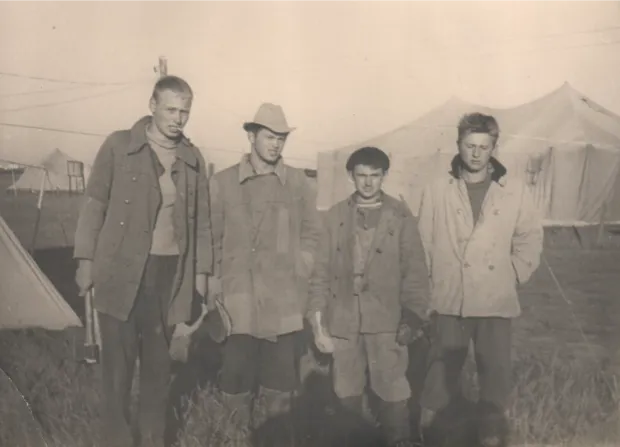
Summer 1966, students of Department E7 of academician N. A. Dollezhal, “Power Machines and Installations,” Bauman Moscow Higher Technical School, Kazakhstan, construction of a cowshed on virgin land. In the tent behind Mikhail Solonin, Viktor Baldin, Aleksandr Musvik, and Aleksandr Bocharov is Viktor Kozlov – their classmate and my father. source